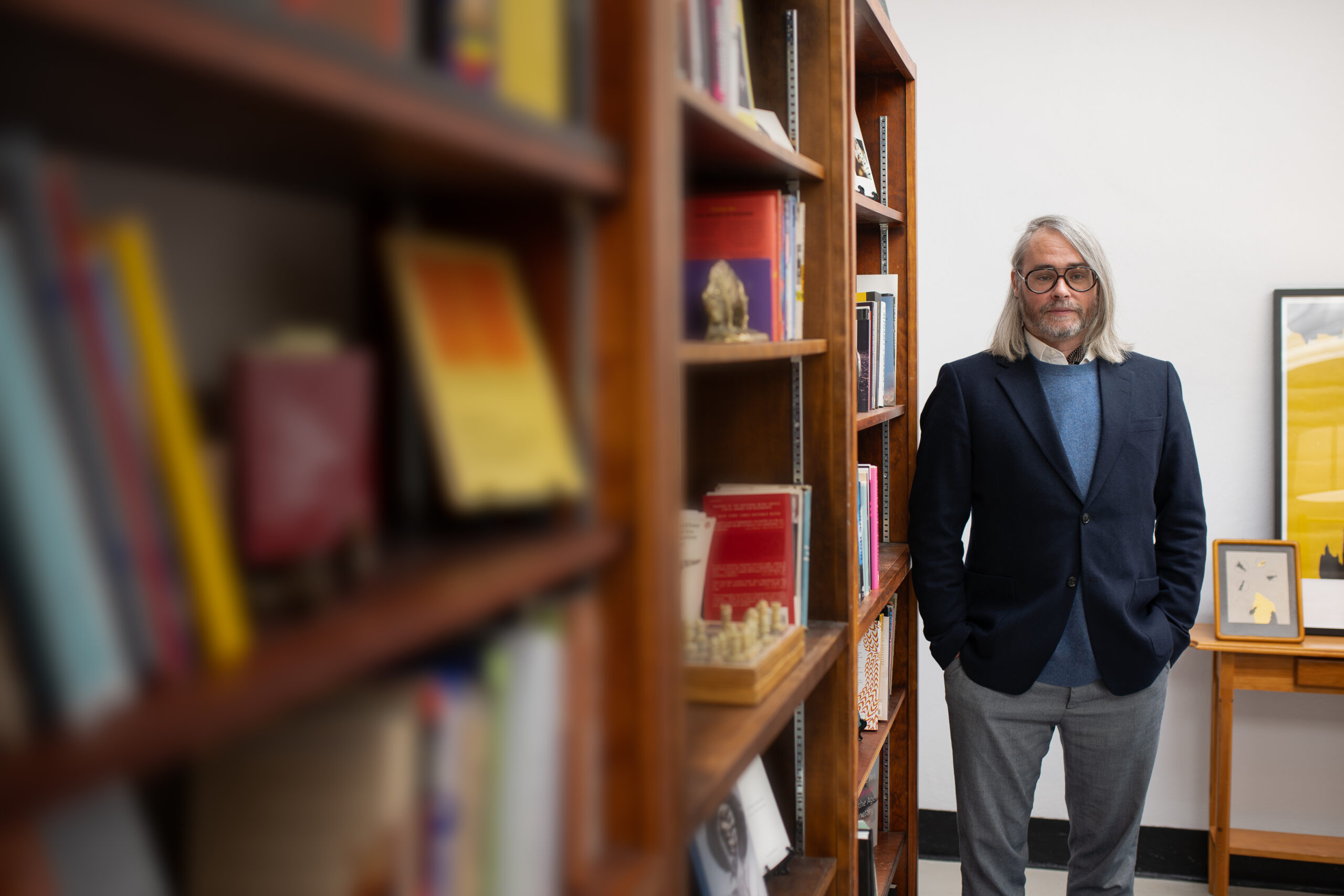
Aaron Tucker is an Assistant Professor in the English Department of Memorial University of Newfoundland and Labrador, where he teaches Media Studies and Creative Writing, and is the Program Director of the Creative Writing Diploma. He is the author of two novels, three collections of poetry, two film studies books, and a forthcoming academic monograph on facial recognition (McGill-Queen’s University Press, Fall, 2026).
Flexible Faces: The History, Software, and Politics of Facial Recognition, will be published with McGill-Queen’s University Press in Fall, 2026 (cover image: Zach Blas). From nineteenth-century scientific efforts to measure and classify faces to the personalized technology that unlocks your smartphone, facial recognition has reinvented itself, insinuating its logic into the fabric of everyday life. Facial recognition technologies (FRTs) have become ubiquitous through integration with computer vision, machine learning, and artificial intelligence. The work is based, in part, on my dissertation “The Flexible Face: Unifying the Protocols of Facial Recognition Technologies” (York University, Cinema and Media Arts) which received the Governor General’s Gold Medal. He currently serves as a member of the Scientific Committee for the fAIces: Etho-Assemblages and Alternative Futures project (University Institute of Lisbon, Portugal), a project funded by the European Union interrogating how do facial recognition technologies shape our sense of self, citizenship, and public life.
He is the author of the novel Soldiers, Hunters, Not Cowboys with Coach House Books, published June 6th, 2023. His essay “A Cowboy’s Work” was longlisted for the 2022 CBC Non-Fiction Prize and is part of a work-in-progress collection of essays.
Tucker’s latest poetry collection is Catalogue d’oiseaux (Book*hug Press, Spring 2021). His novel Y: Oppenheimer, Horseman of Los Alamos (Coach House Books) was translated by Rachel Martinez into French as Oppenheimer (La Peuplade) in the summer of 2020. In addition, he is the author of two other books of poetry, Irresponsible Mediums: The Chess Games of Marcel Duchamp (Bookthug Press) and punchlines (Mansfield Press), and two scholarly cinema studies monographs, Virtual Weaponry: The Militarized Internet in Hollywood War Films and Interfacing with the Internet in Popular Cinema (both published by Palgrave Macmillan).
He is currently the lead of the SSHRC-funding project “The New Past: A History of Canadian AI as Techno-National Project” which is building a critical history of the development of Canadian AI through a variety of archival sources, with a particular focus on deep learning, natural language processing, and Frontier AI. Prior to this, his graduate writing has won the Film Studies Association of Canada Graduate Student Essay Prize as well as the The Ian Lancashire Promise Award at The Canadian Society for Digital Humanities. He was a SSHRC post-doctoral fellow at the University of Toronto in the Faculty of Information recreating the Canadian history of artificial intelligence as a techno-national project.
His collaborative project, Loss Sets, translates poems into sculptures which are then 3D printed (https://aarontucker.ca/3-d-poems/); he is also the co-creator of The ChessBard, an app that transforms chess games into poems (http://chesspoetry.com).
His poetic works and reviews have been published across Canada. His previous chapbook, apartments, was shortlisted for the 2010 bpNichol Chapbook award.
More information can be found at Wikipedia, ELMCIP, and Scalar.
He was born in Vernon B.C. and grew up in Lavington B.C., on the lands of the Syilx Okanagan Nation. You can reach him at [email protected].