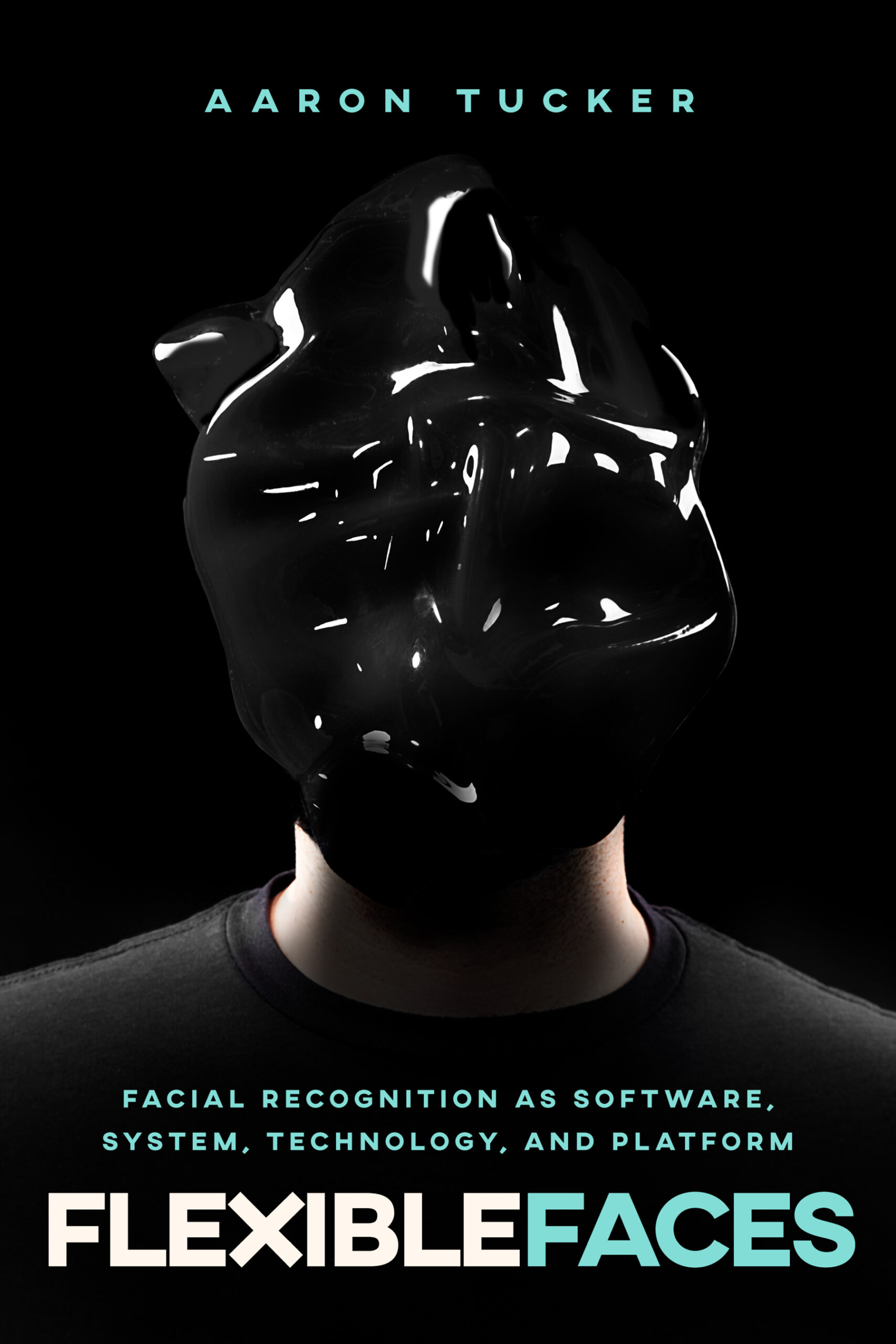
Flexible Faces: The History, Software, and Politics of Facial Recognition (McGill-Queen’s University Press, Fall 2026)
The surprisingly long history of automated facial recognition, a technology entwined with power from its inception.
From nineteenth-century scientific efforts to measure and classify faces to the personalized technology that unlocks your smartphone, facial recognition has reinvented itself, insinuating its logic into the fabric of everyday life. Facial recognition technologies (FRTs) have become ubiquitous through integration with computer vision, machine learning, and artificial intelligence.
Yet, the significance of facial recognition is not its technical prowess, Aaron Tucker argues, but its persistent political project: the sustained desire to render all subjects legible to the state – a drive foundational to its history as a technology of power. Looking back at Francis Galton’s work on vision and eugenics, Woodrow Bledsoe’s 1960s experiments in automated facial recognition, and the first public demonstration in 1970, Tucker traces how FRTs emerged from the convergence of photography, identity documentation, and computer vision. Accelerated by crises such as 9/11 and the COVID-19 pandemic, contemporary FRTs are shaped by eugenic logic and embedded in broader strategies for managing mass mobility. Tucker imagines alternative trajectories to a technology that feels ever more ubiquitous and unavoidable, including tactics that resist, disrupt, and redirect the future development of FRTs as tools of algorithmic oppression and control.
Timely and urgent, Flexible Faces reckons with two centuries of the amorphous and adaptable nature of automated facial recognition, a technology whose systems and software now slip across borders and are interwoven into one’s everyday life, mobility, and citizenship.
Journal Articles and Book Chapters
“Against the Deterministic Cinema of Facial Recognition Technologies” Cinephile. 15(1), 2021. 75-87.
“Incubating AI: The Collaboratory at Ryerson University Library” The Rise of AI: Implications and
Applications of Artificial Intelligence in Academic Libraries. Co-author, peer reviewed book chapter.
McGill University Press. Forthcoming, Spring 2022.
“Photogénie and Facial Recognition Software” Face Forward: New Approaches to the Face on Screen. Book
Chapter. Ed. Alice Maurice. Edinburgh Press. Forthcoming, Spring 2022.
Creative Works
Invited Talks, Workshops, and Conference Presentations:
“Understanding and Hacking Facial Recognition Software.” Vector Festival. Inter/Access. Toronto, ON.
July-August, 2021.
“Poetry and Objects within Loss Sets.” Canada Science and Technology Museum. Ottawa, September 2021.
“The Operative Moment of a Facial Recognition Technology: Data, Portrait, Moving Image”
Trent University, January 2021.
“The Positive Disruptive Potential of Deepfakes and Synthetic Data.” CSDH. Online, June 2021.
“The Biopolitics of Recognition within Facial Recognition Technologies.” FSAC. Online, June, 2021.
“The FERET Database: Building the Infrastructure for Future Facial Recognition Software.” CCA. Online. June, 2021.
“Solving the Conflict Between Breathability and Masked Faces within Facial Recognition Technologies.”
Online. SCMS. March 2021.